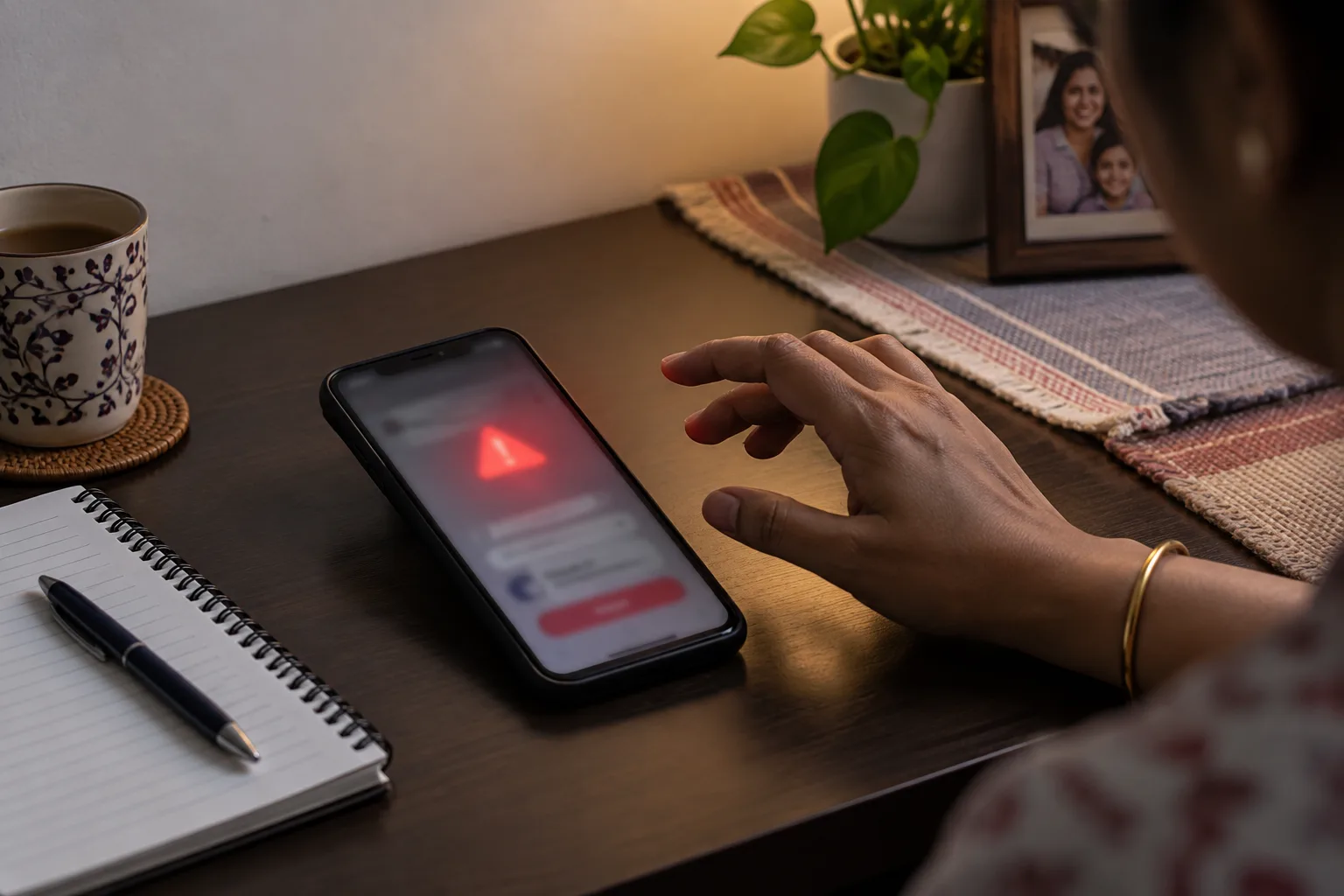
Immediate answer: stop if a recruiter asks for registration, security, courier, GST, ID-card or salary-release money. A logo, appointment letter or WhatsApp account does not establish who controls the payment destination.
Use the independent-channel test
Write down the legal employer name, job title, location, recruiter name, email domain and every fee. Then leave the message. Find the company website yourself, not through the link the recruiter sent. Use the contact or careers channel published on that site and ask whether the vacancy, recruiter and application path are genuine. A spelling match is not enough: impersonators can reuse addresses, logos and employee photographs.
Worked example: a message says a courier will deliver pens after a ₹750 refundable registration payment. Do not pay “just to test it.” Verification means contacting the purported employer through its independently located official channel and confirming the exact arrangement in writing.
Six claims that need proof
- The employer exists: identify the legal entity, not only a product brand.
- The vacancy exists: locate it on an official careers page or obtain confirmation from an official domain.
- The recruiter is authorised: personal WhatsApp and free email accounts require extra caution.
- The work location is real: “near me” does not prove a local office or delivery route.
- The pay calculation is complete: ask who bears rejected goods, transport and tax costs.
- No advance payment is needed: do not pay to receive work, wages or a refund.
Protect identity documents
Do not send full Aadhaar images, banking credentials, OTPs, PINs or remote-screen access. If a legitimate employer later requires identity verification, confirm the purpose, recipient, storage and minimum fields. Watermarking a necessary copy with purpose and date can reduce reuse, but cannot make an unverified recipient safe.
If pressure starts
“Last slot,” “pay before the truck leaves,” and “your salary is blocked” are reasons to pause. Save the message, profile, number, payment request and URL. If money has moved, contact the financial institution promptly and use India’s cyber-fraud reporting routes. This guide cannot promise recovery; speed and complete evidence can still matter.
Read the offer as a process, not a poster
A polished advertisement shows what the sender wants you to see; a hiring process reveals who is accountable. Look for a vacancy reference, a role description that names the actual employer, an application trail on a controlled domain, an interview that tests relevant ability, and written terms before sensitive onboarding. A process conducted entirely through disappearing messages gives the applicant little evidence and the sender too much control.
Check whether each step makes operational sense. If boxes will be delivered, who owns the materials, insures loss, inspects quality and pays return transport? Where is the written rejection rule? If the sender cannot answer but can immediately calculate a fee, the offer is not ready to trust.
Questions to ask without revealing more data
- What is the employer’s full legal name and official website?
- Where is this vacancy published by that employer?
- What is the written contract type, location and payment schedule?
- Which company email will confirm the recruiter’s authority?
- Why is any applicant payment required, and where is that policy published?
Avoid sending Aadhaar or bank information merely to receive these answers. A genuine recruiter should be able to explain the role before collecting high-risk data.
False reassurance to ignore
Video calls, office photographs and identity cards can feel personal without proving authority. A caller may know your city or repeat an address found online. Testimonials may be recycled, and a small first refund may be used to encourage a larger transfer. Verification is based on control of the official channel and consistent written terms, not on confidence, friendliness or production quality.
FAQ
Does “no investment” make the offer safe? No. The fee may appear later under another name, or the real target may be identity data.
Can I pay if the amount is refundable? A refund promise is only as reliable as the verified party making it. Do not use it as proof.
Should I visit an office? Verify the address and employer first, tell someone your plan and avoid informal private meeting points. A physical location alone does not validate a contract.
Editorial judgment
A packing offer built around a chain of small advance charges is not made credible by professional graphics or a familiar brand. The safe default is no payment and independent verification. Missing one unverified offer is less harmful than losing money and identity data to an impersonator.
Sources checked
- Press Council of India — October 2023 Review, pages 181–184Checked 23 September 2026
- National Cyber Crime Reporting PortalChecked 23 September 2026
- Ministry of Home Affairs — NCRP and helpline 1930Checked 23 September 2026
Next useful step
Return to Verify an Offer, read the editorial method, or send a documented correction through Contact.